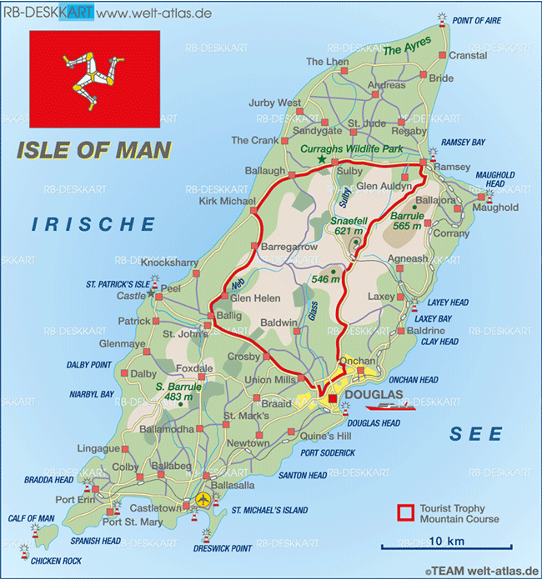
Yes. The Isle of Man (also simply called “Mann”) is a self-governing Crown Dependency and is not part of the United Kingdom. At 33 miles long and 15 miles wide, Mann is not a country, not a territory (like Bermuda or the Falkland Islands), and not a member of the European Union. Queen Elizabeth was, and King Charles III is now, the Lord (never Lady) of Mann. They do use the British pound, the UK is responsible for its defense, and Brits sometimes use the Isle of Man as a tax haven.
The British Isles are made up of Ireland, Northern Ireland, Scotland, England and Wales. Irish nationalists say “the British Isles and Ireland.” The “Atlantic archipelago” is also sometimes used.
Other islands include the Isle of Man, Wight, Scilly, Skye, the Arran Islands, Channel Islands, Shetland Islands, Inner and Outer Hebrides, Orkneys, and over 6,000 other smaller islands.
The United Kingdom (owned by the British crown) is a political union made up of Northern Ireland, Scotland, England, and Wales. Wales and Scotland are their own countries; however, a referendum on independence for Scotland was held in 2014, losing by only a small margin. A second referendum is scheduled for 2023. England is considered a semi-autonomous region.
Great Britain is a geographical term describing the land mass that incorporates Scotland, England, and Wales. Northern Ireland is not geographically part of Great Britain.
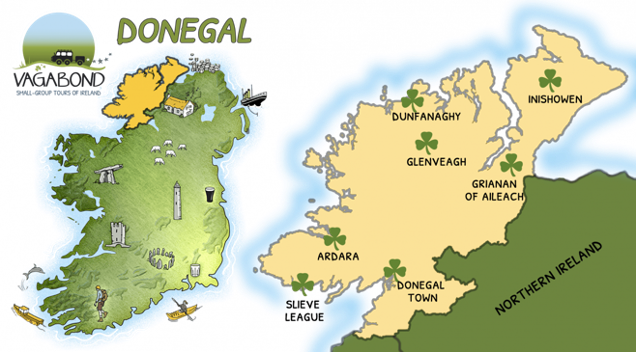
Donegal is sometimes called “Ireland’s Forgotten County” and is, among all of the island’s 26 counties, the most rural and least urbanized. It is considered part of the ancient and historical province of Ulster, but it is not part of the UK’s Northern Ireland. The story goes that Donegal was not included by the British Government in creating Northern Ireland in 1922 because almost half the population was Catholic. So, geographically Donegal is remote, politically it is unique, and economically it is fragile with regard to Brexit. County Donegal was the worst affected part of Ulster during the 1840s Great Famine. Many areas became permanently depopulated.
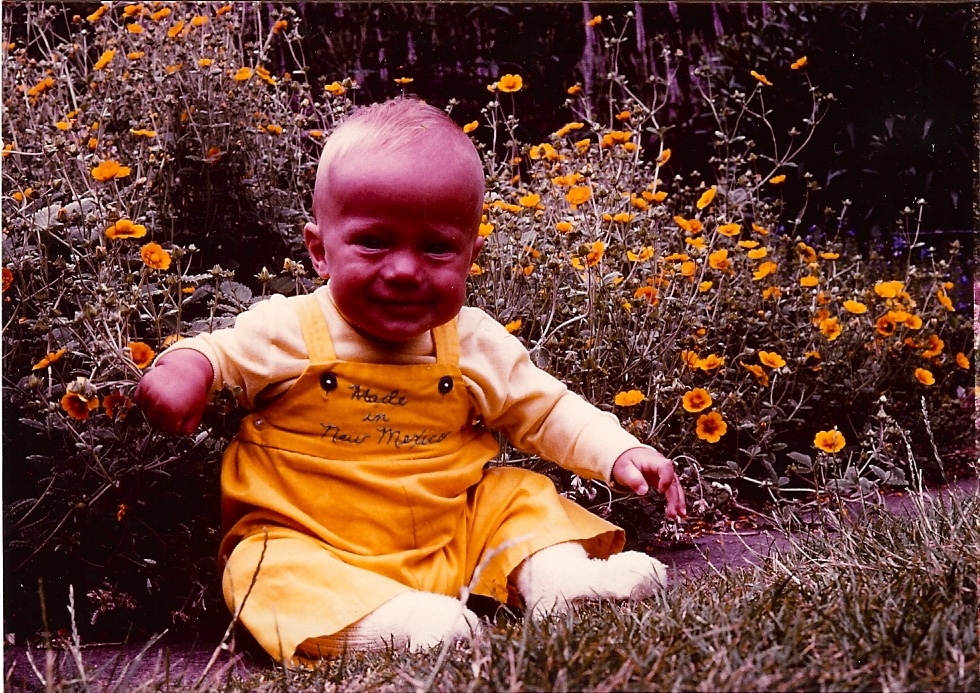
This was my mom talking. “Why would you want to take a baby to England? He won’t remember anything!” I had just announced our trip plans and that Sam, seven months old, would be going with us. She may have been hinting that Sam should have stayed with her while Sam’s father and I gallivanted around the British Isles for three weeks. But that wasn’t our plan. Sam was going with us. No other way of doing it. Our trip was not about just having fun as a couple. We’d had plenty of that before Sam came along. This was an inclusive, family experience. He wasn’t just a baby to us, he was us.
In the Royal Botanical Gardens, Edinburgh, Scotland
Sam was a part of everything, from the long flights from Albuquerque to Newark to Heathrow and then visiting sites throughout England and Scotland. He was at every English breakfast table, at Edinburgh Castle, various botanical gardens, the Tower of London, the Lake District where we fed ducks, geese, and swans, and watching some Highland Games in Scotland.
I’m an artist on vacation, but I’m not always sketching and painting. England certainly provides a country full of color, including just about every variation on leaf and grass. Consider a few of the descriptors for the color green: apple, ash, Australian, beryl, black, blue, Bohemian, bronze, Chinese, chlorophyll, chrome, cinnabar, cold, earth, emerald, fir, forest, French, grass, Ionian, Kelly, lagoon, leaf, lizard, May, mossy, neon, office, olive, oxide, Paris, pea, phthalo, pine, Reseda, Rowney, sage, sap, shamrock, spring, spruce, sunlit, tea, terre verte, tropical, turquoise, umber, verdigris, Verona, and viridian. Whew! And they’re all here in the UK! You’d think this visitor, a desert visitor no less, would enthusiastically seek capturing them all.
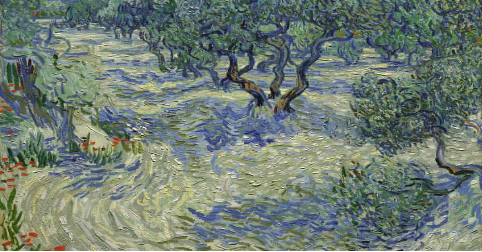
I do carry a fat little sketchbook for when the mood strikes, and, on yesterday’s mostly sunny day, I could have been drawing en plein air. I’ve never been particularly enthusiastic about painting outdoors, and when I have done so, I’ve been irritable about the flies, sand, wind, and rain. Claude Monet and Vincent Van Gogh certainly recorded their complaints. One of Van Gogh’s works, The Olives (below)* even has a grasshopper’s head and hind legs entombed in the oil paint. Van Gogh expert Martin Bailey comments, “He either didn’t notice—or perhaps didn’t care—and carried on . . . .”
* The insect parts are in the lower right sector of the painting. You can view The Olives in the collection of the Nelson-Atkins Museum of Art in Kansas City, Missouri.
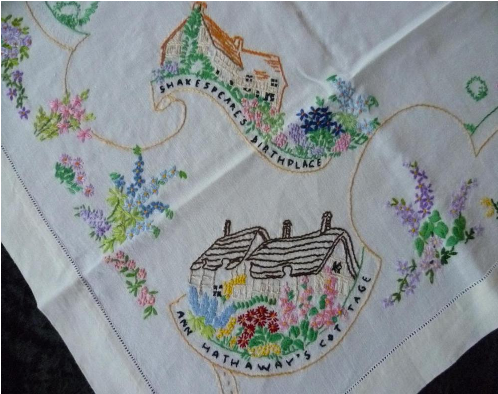
Anne Hathaway’s cottage lies amid gardens and fields of roses, rushes, lavender, and delphiniums, in Shottery, Warwickshire, a mile outside the city center of Stratford-upon-Avon. Lovely willow trellises line the walks of the “cottage” that is actually a rather substantial, 12-room farmhouse and was called Hewlands‘s Farm during the Elizabethan era. The nine acres of grounds are covered with winding tendrils of vine and vegetable. I believe Anne’s family house is a more beautifully floral tourist experience than her husband William Shakespeare’s birthplace in the town center.
An embroidered tea towel with Anne’s cottage
Shakespeare’s birthplace in Stratford has some grounds, though they’re more formal and much smaller than those at the Hathaway cottage. In fact, once your visit to Shakespeare’s birth home is done and you seek a feeling of “this is how is was,” I found exploring the River Avon a much more natural experience. The trees, plantings, and water features with the weirs, locks, dams, riffles, and water lilies were delightful and away from the press of tourists. The walk is mostly flat and, though it’s sometimes muddy, not too demanding. You will likely find the introverts walking around.
I was a small girl in California when I’d first heard of the ichthyosaurs. My mother had read me Isabel Frances Bellous’s poem “The Ichthyosaurus.”
There once was an ichthyosaurus, Who lived when the earth was all porous, Be he fainted with shame When he first heard his name, And departed a long time before us.
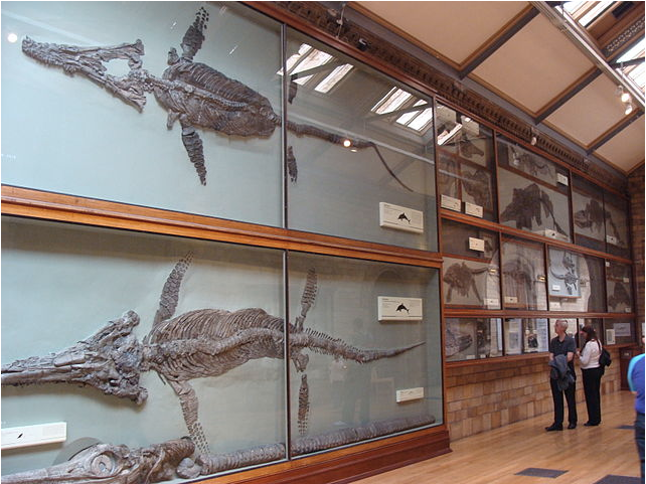
My mother might have mentioned that Mary Anning—who hunted for fossils and the world’s first ichthyosaur skeleton—lived on a beach like I did. She might have mentioned that Mary had tremendous energy and intellect, yet wasn’t taken seriously. I remember the black-and-white sketch of an ichthyosaur illustrating the poem.
Ichthyosaur skeletons, Museum of Natural History, London(Continued)
His name was Michael, the odd man who took our gaggle of teachers on adventures after the British Infant School education workshop in 1978. Michael explained English history and culture, and he made some extra cash. One such adventure was to see the White Horse of Uffington in the Berkshire hills.
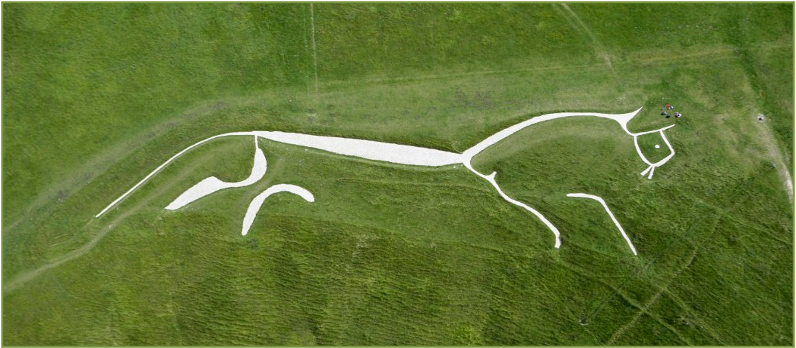
The White Horse of Uffington
Locals had originally thought the minimalist horse design had been shallowly scratched through the grass into the chalk and was therefore unable to be dated. It may be a minimalist design, but this design is huge: 360 feet long and 130 feet wide. A research team discovered the figure was actually cut up to three feet deep into the hill. That meant it was possible to use the technique “optical stimulated luminescence” to date layers of quartz in the trench. Scientists discovered the design was actually a Bronze Age piece of hill art at least 3,000 years old. During World War II, that quartz outlining the horse was covered over with turf and hedge trimmings so Luftwaffe Stuka dive-bombers couldn’t use it for navigation.
Perhaps a country shows its true colors through its bank notes. In 1928, the US Treasury Department reviewed the portraits on bank notes and concluded that “portraits of Presidents of the United States have a more permanent familiarity in the minds of the public than any others.” Exceptions were made for Alexander Hamilton, Salmon Chase, and Benjamin Franklin. Changes in the faces depicted on US currency (intended for the general public) have not been made since 1928.
In contrast, portraits on English bank notes change regularly and have honored scientists, writers, engineers, musicians, social reformers, and politicians. Right now [2014], their currency honors Matthew Boulton and James Watt on the 50-pound note, Adam Smith on the 20, Charles Darwin on the 10, and Elizabeth Fry on the 5. (England does not have a 1-pound note. That denomination is a coin, shown at left.)
I had never heard of Elizabeth Fry, so, as I paid for my latte and pain au raisin at a Caffe Nero recently, I asked the young man behind the counter who the woman was on the fiver. The barista shrugged saying, “I guess she’s somebody who’s dead.”